ARTIST STATEMENT
On painting
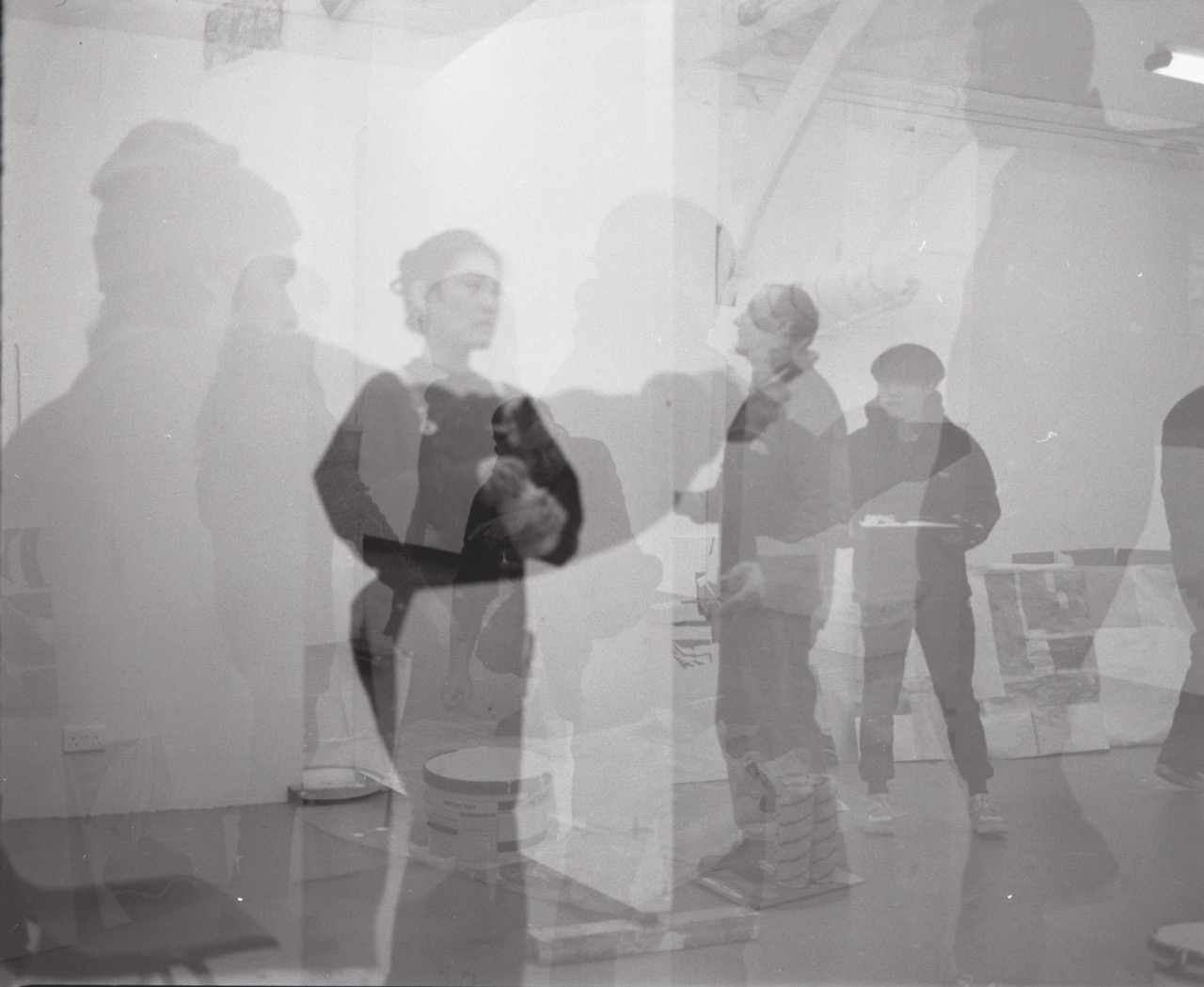
MA Fine Art: Painting 25′ (Alberto, Tianqi, Susu, Charles, Chauncey-Chenxi, and Michael)
Medium format film photograph; multiple exposure negative (digital scan)
Camberwell College of Arts, South London (UAL) / 2024
Regarding painting as material practice intersecting perception, psychotherapy, and social engagement, the visual work serves as a channel for experiencing and also sharing human transcendence. Images become powerful markers of the subjective perspectives from which we each derive meaning in our daily life. Every spectator–the painter and the observer–interprets the arbitrary arrangement of abstract traces of paint as content projecting a narrative of their own experience and thought. This involves a seemingly spontaneous encounter by which the spectator comes to interpret forms and colors as carriers of signs and symbols acquiring personal value. In this way the creative process of looking involves a means for identification and self-reflection through a primordial language that operates beyond rhetoric, discourse, and fixed categories.
In my practice, I use painting as a device in relation to landscape, a traditional genre associated with the illusion of setting. Like painting, the setting is inherently ambiguous and subjective; much like images, every location is a build-up of symbolic layers which are personal as well as social. Through matters of chance, extension, texture, rhythm, and other parameters dealing with the action of shaping the form and space in our surroundings, every landscape displays a shared ground which exposes our social and political dilemma; conflicting perspectives and interests cohabit in the same finite, shared space. Placed in settings, our built tendencies and accustomed views are brought to the surface of conscience, and we’re given the chance to reflect on them. I believe the discussion that arises from this reflection is part of what can help mobilize our actions and encounters at any given moment.